iRace Digital onboards institutional clients across three jurisdictions and several entity types. HST works across that whole estate: the shared data model everything sits on, the regulatory forms that run on top of it, and the move of the existing journeys onto the same foundation. This page sets out the onboarding workflows involved and what each one needs from the platform underneath.
iRace Digital, trading as FundBank, provides banking and fund services to institutional investors, fund structures and asset managers. Client entities sit in the United States, Luxembourg and the Cayman Islands, so onboarding has to satisfy three supervisory regimes at once.
Onboarding is where a bank’s financial crime obligations turn into software. Customer due diligence, beneficial ownership, sanctions and politically exposed person screening, source of funds, tax transparency and client categorisation are all asked of the same client at the same time, and evidenced on the same record.
HST works across the estate rather than on one deliverable. That covers the shared data and portal foundation, the digitisation of each regulatory form, keeping the existing live journeys running while the work happens, and leaving the bank’s own team a pattern they can extend themselves.
The approach is to treat onboarding as a family of related workflows rather than a set of separate forms. Once the shared parts exist, adding a new workflow is mostly configuration.
These look similar on a requirements document. They behave very differently once real clients use them, which is why they are worth separating.
| Workflow type | What makes this one hard | How it is built |
|---|---|---|
| Institutional and fund entity onboarding |
| One record per party and role instead of numbered slots. Directors, beneficial owners, controllers, signatories and politically exposed persons are limited by the client's structure, not by the schema. Jurisdictional variation is handled with conditional steps on a shared journey rather than a separate front end per route. |
| Service provider and delegate capture |
| The same party model with a provider flag, covering administrator, auditor, custodian, prime broker, investment adviser, manager and legal counsel. Where one firm holds two roles, two role records point at the same organisation rather than copying its details onto the application. |
| Mandate, authority and approval rules |
| Approval rules are held as records: transaction type, value band, approval condition and sequence, with authorised persons and their access rights alongside. New bands and approver combinations do not need a schema change, and the business can maintain the condition list itself. |
| Regulatory categorisation by assessment |
| A conditional questionnaire captures the qualifying tests and criteria and calculates the category. Any opt-up is stored as a separate confirmation. The conditional logic uses the platform's own rules rather than custom code. |
| Declaration and self-certification |
| Classification drives the flow. A passive entity opens the controlling persons branch, and the same tax residence component is reused for the account holder and for each controlling person, so the nesting reuses a module instead of needing new screens. |
| Documentary evidence and review |
| A requirement record states what is needed and why it applies. Document records hold each version with its issue and expiry dates, review status, reviewer and comments. A reissued certificate does not overwrite the previous review. |
| Internal review, decision and escalation |
| Review and decision records with assigned teams, outcomes, comments and dates, shown through the internal views the business already uses. Where automation fails it raises a visible exception instead of reporting success. |
| Remediating a live estate |
| Legacy and modular routes run side by side in one environment. Active applications are not switched mid-journey. Domains move one route at a time and keep their legacy reference for traceability. Old structures come out only once forms, flows, reports and integrations no longer use them. |
One record per party and role instead of numbered slots. Directors, beneficial owners, controllers, signatories and politically exposed persons are limited by the client’s structure, not by the schema. Jurisdictional variation is handled with conditional steps on a shared journey rather than a separate front end per route.
Why we separate them. A team that has only built the first type tends to model the fifth the same way. The branching, the nesting and the audit requirements then turn up part-way through the build. Working out which type you are dealing with before the data model is written avoids most of that.
The application record stays narrow and holds the journey. Everything that repeats (parties, addresses, identifiers, activity profiles, documents, form answers) is held as related records. Adding a workflow adds records rather than columns.
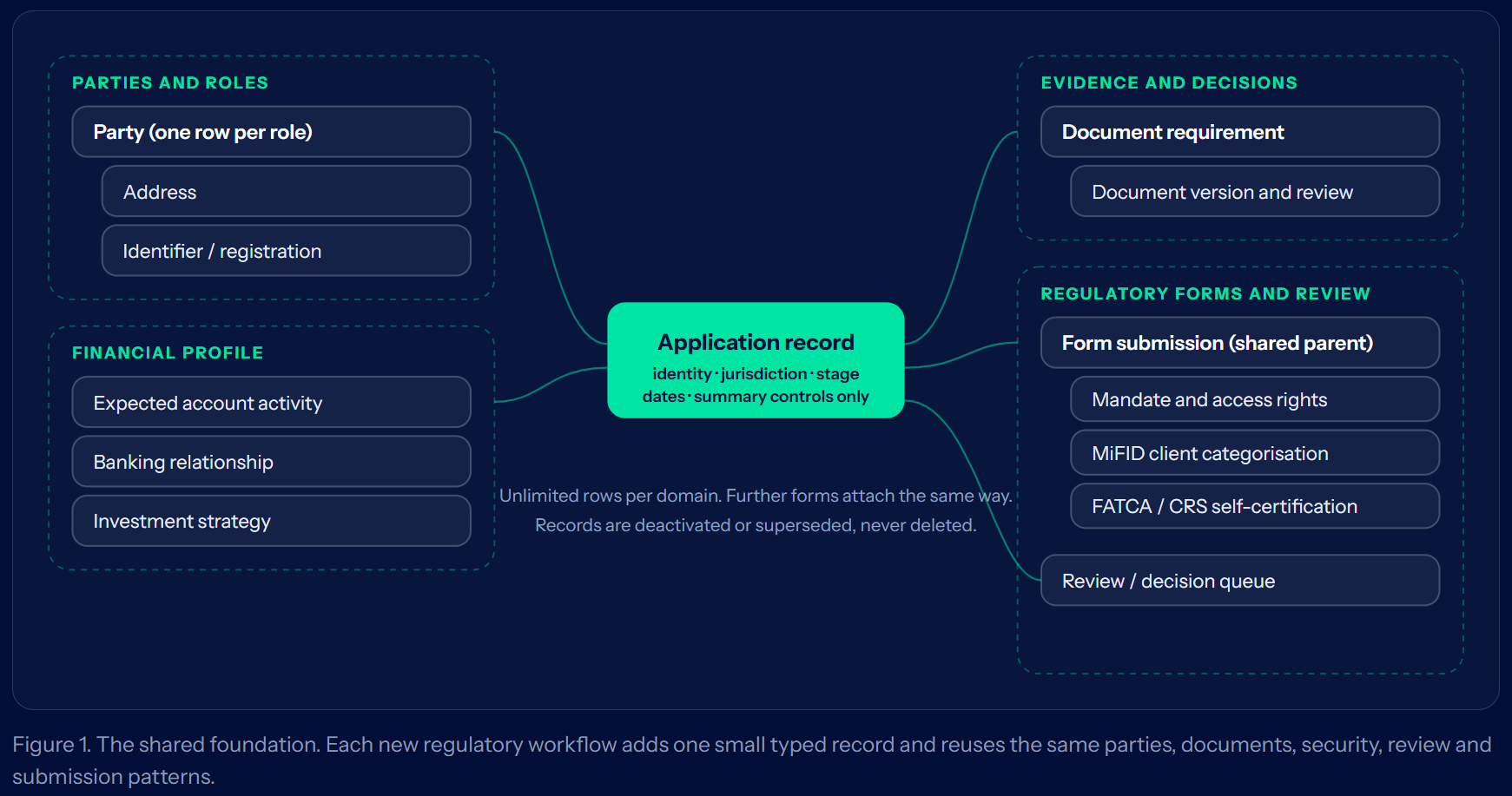
What we test the design against.
A new form, or a newly migrated domain, should be deliverable by adding one small typed table and standard configuration, reusing the existing submission, security and review patterns. No new question columns on the application record, and no custom front end.
Onboarding architecture only holds up if each structure traces back to the obligation it serves. This is the mapping the design works to.
Ownership and control percentages, party type and screening status held per party and role, with no ceiling on how many of them a structure can have.
A record per direction, channel, currency and period, covering wires, ACH and digital asset movements, with expected volumes and counterparty countries. This is the baseline monitoring is later calibrated against.
Classification, registration number or the reason none is held, and the declaration, over unlimited tax residence and controlling person records with their own residences and indicia.
A category reached by evidenced test rather than by assertion, with any opt-up stored as an explicit confirmation.
Value bands, approval conditions and approver combinations held as data, so a change to the bank’s mandate policy is a configuration change rather than a release.
Strategy, asset class, geography and allocation held as structured records, so jurisdictional exposure can be queried rather than parsed out of free text.
Issuing country and authority, validity dates and status per identifier, with field-level security where the data is sensitive.
Deletion restricted on application-scoped records, with rows deactivated or superseded instead. Migrated records keep their legacy reference so their history survives the migration.
Changing onboarding while clients are mid-application is mostly a sequencing problem. This order keeps each step reversible.


Building for the family rather than the form is what makes the next workflow cheap. These are the ones the existing patterns already support.
Each is a small typed record plus standard configuration on the shared submission, security and review patterns. No custom front end, and no regression risk to the forms already live.
A review cycle has the same structure as an onboarding one: a submission, changed child records, evidence and a decision. Because history is kept rather than overwritten, a refresh can show what actually changed since the last one.
Enhanced measures attach to the party or relationship that triggered them rather than to one flag on the application, so a higher-risk party carries its own evidence requirements and review path.
Missing or expired evidence across a book of clients becomes a queue of requirement records with owners and due dates, rather than a spreadsheet somebody maintains by hand.
A new supervisory regime becomes conditional steps and jurisdiction-specific requirement rules on the shared journey, rather than a fourth parallel front end to keep in sync with the other three.
No custom questionnaire engine and no plug-in-heavy application, so the bank’s makers can extend the solution with standard Power Platform skills.


Client onboarding and KYC involve collecting and validating information about institutional clients, including customer due diligence, beneficial ownership, sanctions and PEP screening, source of funds, tax transparency and client categorisation.
iRace Digital provides a client onboarding and KYC foundation for institutional clients, covering shared data, regulatory forms, onboarding workflows, review processes and the migration of existing client journeys.
The onboarding estate supports institutional clients across the United States, Luxembourg and the Cayman Islands, with jurisdiction-specific requirements handled within shared onboarding journeys.
The platform supports institutional and fund entity onboarding, service provider and delegate capture, mandate and approval rules, regulatory categorisation, declaration and self-certification, documentary evidence and review, internal review and escalation, and remediation of existing live workflows.
The data model records parties and their roles, including directors, beneficial owners, controllers and signatories. It is designed to support varying numbers of parties based on the client’s structure rather than using a fixed number of fields.
Requirements are stored according to what is needed and why it applies. Document records maintain versions, issue and expiry dates, review status, reviewer information and comments, allowing previous reviews to remain traceable when documents are reissued.
The model covers areas including KYC/CDD, enhanced due diligence, beneficial ownership, AML, FATCA, OECD CRS, MiFID II client categorisation, mandate control, record keeping and regulatory data architecture.
The shared platform foundation uses Microsoft Dataverse, Power Pages, Power Automate and Dynamics 365, with a no-code-first approach.
“Nova Leah has been working with HST for the past few years, and our experience has been exceptional. As a startup, we needed a partner who could deliver not just technical excellence but also understand our unique needs and growth pace. HST has more than delivered.
The team's technical expertise is outstanding. They've consistently provided innovative, scalable solutions that align perfectly with our needs. What impresses us most is their flexibility—whether it's scaling up quickly or adapting to new requirements, they've been able to pivot and respond swiftly without compromising on quality.
HST feels like a true extension of our in-house team. Communication is effortless, and their proactive approach has fostered a collaborative and transparent working relationship. Despite being an outsourced team, their commitment to our goals and values has been evident from day one.
For any startup looking for a reliable and innovative development partner, HST is a perfect fit. Their understanding of the startup environment, combined with their ability to deliver high-quality solutions quickly, has been very impressive.
In summary, HST has been a fantastic partner, the management team have been wonderful to work with - who worked diligently to provide technical excellence, flexibility, and seamless integration with our team. We highly recommend them to any company looking for a top-notch software development partner.”

Waystone has been collaborating with HST Solutions for several years now, and our experience has been outstanding. Partnering with HST has significantly helped us develop scalable, secure, and efficient technology solutions that underpin our operations.
HST’s technical expertise is truly remarkable. They've delivered a robust data management framework including customized ETL, a well-structured data warehouse, and tailored reporting that aligns seamlessly with our enterprise-wide needs. Their ability to adapt to our evolving requirements while maintaining quality has consistently impressed us.
What stands out most is how smoothly HST integrates with our internal teams. Communication is straightforward, and the proactive approach of their developers and project managers fosters a collaborative and transparent working relationship. They’ve quickly become a trusted extension of our workforce, fully committed to our shared objectives.
For any organization aiming to streamline data processes or expand their product offerings based on reliable, single-source data, HST is an ideal partner. Their combination of technical know-how, flexibility, and swift turnaround times provides real value and the agility we need to grow.


Your product, our dedicated team. From concept to conception, we handle it all.