The unique on-chain identifier. Case is preserved exactly, because several networks are case sensitive and normalising an address destroys it.

A bank can use a custody vendor. It still has to keep its own record of what it holds, run its own checks before value moves, and be able to show a supervisor how a decision was made. HST is building the platform that does that for iRace Digital, from the daily custody record through to instructions that settle across fiat and digital asset systems at the same time.
iRace Digital’s custody platform is authoritative for custody. It holds the vaults, applies the policies, runs the screening and executes on chain. That is how it should be, and it does not cover everything the bank is responsible for.
The bank has to produce its own position at a defined cut-off and reconcile it. It has to keep the evidence behind a decision in a form it controls, for as long as its own retention policy says. It has to run its own checks before value moves, rather than record what the custodian decided afterwards. And when an instruction touches a fiat account and a digital asset at the same time, one system has to own the whole instruction, because a partly settled trade affects client money.
None of that is something a custody vendor sells. It is the bank’s own operating layer. These are also the same obligations HST engineers at the front of the client relationship, in due diligence and onboarding, applied to what happens after the account opens.
The boundary we drew first. The platform does not recreate what the custody vendor is authoritative for: vault custody, its policy engine, its screening integration, cryptographic signing and blockchain execution. It never holds key material. What it owns is the bank’s record, the bank’s controls and the bank’s orchestration. Getting that line right early is what stops the two systems merging into one system nobody can maintain.
Establish the bank’s record first, then the controls that depend on it, then the orchestration that depends on both. Doing it the other way round means moving client value through a system that cannot yet prove what it did.
The client channel stays client-facing. The custody platform stays authoritative for custody. Everything the bank itself has to own sits between them.
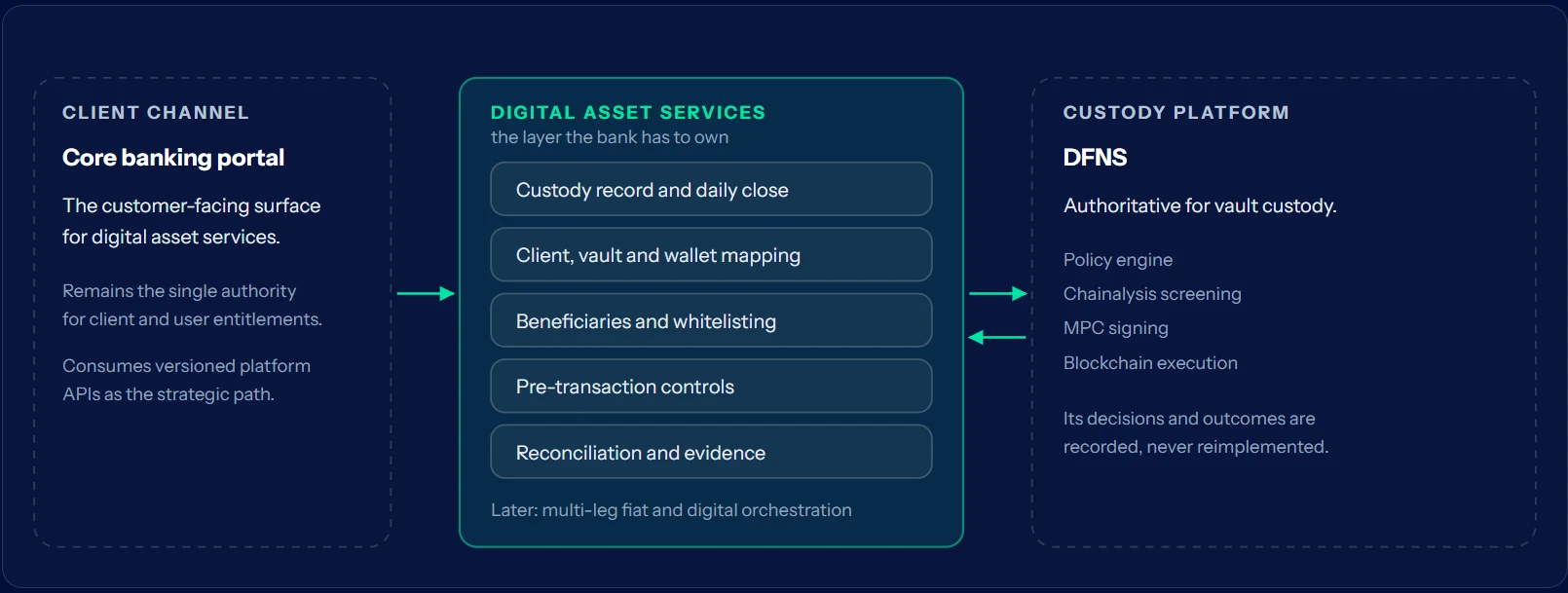
Figure 1. The responsibility model. Each system keeps what it is genuinely authoritative for, which is what makes the boundary between them stable enough to build on.
Digital asset custody is a new venue for some quite old disciplines. The engineering only holds up if each decision traces back to the control it serves.
The bank’s own custody record, rebuildable entirely from source evidence it kept itself, so it survives a vendor outage, a contract change or an API deprecation.
An immutable position per business date, client, vault and asset at a fixed cut-off, with an explicit completeness result. A closed accounting period rather than a cached query.
A missing position and an empty position are different facts. A failed retrieval is recorded as an auditable exception and never reported as zero.
Amounts converted between the raw on-chain unit and the displayed value using per-asset precision rules, with environment-specific reference data validated before deployment. A test asset reference in a production position is a silent error, so it gets checked.
Two independently derived views held on purpose, so divergence shows up as a break rather than as an assumption nobody tested.
Screening results kept as the bank’s own evidence with the provider’s reference preserved, and re-screening at transaction time rather than relying on a check run when the record was created.
A beneficiary and address book the bank owns: duplicate prevention, per-network whitelisting, VASP or unhosted-wallet classification with enhanced verification for the latter, and approved addresses deactivated and recreated rather than edited in place.
Two-factor and maker-checker approval on whitelisting and on outbound value, with approval chains kept immutably, and the whitelist and screening revalidated immediately before submission rather than only when the request was raised.
Inbound value held until the required controls pass. Where the source address is not in the client’s address book, the client is asked to register it before release. Nothing releases by default.
Counterparty and transaction context kept from the start, so the obligation can be met operationally now and automated later without having to reconstruct history.
One correlation identifier carried across the fiat, trading and custody legs, every leg reconciled and a definite outcome returned, so a partly settled instruction is a known state with a defined remedy.
Custody records logically segregated by banking jurisdiction and routed to the corresponding regional instance, validated for no cross-jurisdiction leakage.
Every command and vendor request keyed on a stable identifier and tolerant of retry and out-of-order arrival, which is what makes rebuilding the record from evidence a routine operation.
One controlled vocabulary across screens, specifications, database design and client communication, with product-facing statuses kept separate from raw vendor statuses.
Loose language in digital assets causes real defects. “Address” on its own has meant three different things in three different specifications on this programme alone. One agreed glossary covers screens, specifications, developer documentation, database design and client communication.
What it changes
Digital asset services provide the technology, infrastructure and operational capabilities required by institutions to securely manage and operate digital assets.
iRace Digital supports institutional digital asset operations through technology and infrastructure designed to help organisations manage digital assets and related operational processes.
Digital asset services are designed for institutional organisations that require secure and scalable infrastructure to support their digital asset operations.
Digital assets require controlled infrastructure for managing access, transactions, operational processes and security. Secure infrastructure helps institutions manage these activities in a controlled environment.
Digital asset infrastructure can bring together technology, security and operational processes to support the management of digital assets at an institutional level.
Digital asset services form part of the broader technology capabilities provided by iRace Digital for institutional financial and digital asset operations.
“Nova Leah has been working with HST for the past few years, and our experience has been exceptional. As a startup, we needed a partner who could deliver not just technical excellence but also understand our unique needs and growth pace. HST has more than delivered.
The team's technical expertise is outstanding. They've consistently provided innovative, scalable solutions that align perfectly with our needs. What impresses us most is their flexibility—whether it's scaling up quickly or adapting to new requirements, they've been able to pivot and respond swiftly without compromising on quality.
HST feels like a true extension of our in-house team. Communication is effortless, and their proactive approach has fostered a collaborative and transparent working relationship. Despite being an outsourced team, their commitment to our goals and values has been evident from day one.
For any startup looking for a reliable and innovative development partner, HST is a perfect fit. Their understanding of the startup environment, combined with their ability to deliver high-quality solutions quickly, has been very impressive.
In summary, HST has been a fantastic partner, the management team have been wonderful to work with - who worked diligently to provide technical excellence, flexibility, and seamless integration with our team. We highly recommend them to any company looking for a top-notch software development partner.”

Waystone has been collaborating with HST Solutions for several years now, and our experience has been outstanding. Partnering with HST has significantly helped us develop scalable, secure, and efficient technology solutions that underpin our operations.
HST’s technical expertise is truly remarkable. They've delivered a robust data management framework including customized ETL, a well-structured data warehouse, and tailored reporting that aligns seamlessly with our enterprise-wide needs. Their ability to adapt to our evolving requirements while maintaining quality has consistently impressed us.
What stands out most is how smoothly HST integrates with our internal teams. Communication is straightforward, and the proactive approach of their developers and project managers fosters a collaborative and transparent working relationship. They’ve quickly become a trusted extension of our workforce, fully committed to our shared objectives.
For any organization aiming to streamline data processes or expand their product offerings based on reliable, single-source data, HST is an ideal partner. Their combination of technical know-how, flexibility, and swift turnaround times provides real value and the agility we need to grow.


Your product, our dedicated team. From concept to conception, we handle it all.